

How Vancouver’s Back-to-School Rush Breaks Appliances
Wondering why your washing machine suddenly breaks down or your dishwasher stops working during September back-to-school preparations? The truth is, back-to-school season creates a perfect storm of appliance stress through intensive laundry loads, compressed meal preparation cycles, and electrical system overloads that can destroy even well-maintained household equipment in just a few weeks.
Picture this: it’s the first week of September in Vancouver, and your family is scrambling to get three kids ready for their new school year. You’re running load after load of laundry to prepare uniforms, washing bedding that’s been neglected all summer, and your dishwasher is working overtime processing the extra dishes from increased meal prep. Then suddenly, your washing machine starts making that grinding noise, your dishwasher won’t drain, and your refrigerator is struggling to keep things cool. Sound familiar?
This isn’t just bad luck – it’s a predictable pattern that appliance repair services across Vancouver see every single September. The back-to-school rush creates unique stress conditions that push household appliances beyond their design limits, leading to failures that could have been prevented with the right knowledge and preparation.

Key Outtakes:
- September appliance failures spike 150-200% during back-to-school season due to intensive usage patterns and electrical system overloads
- Washing machines are the most vulnerable appliances, with overloading during laundry prep causing motor burnout and suspension system damage
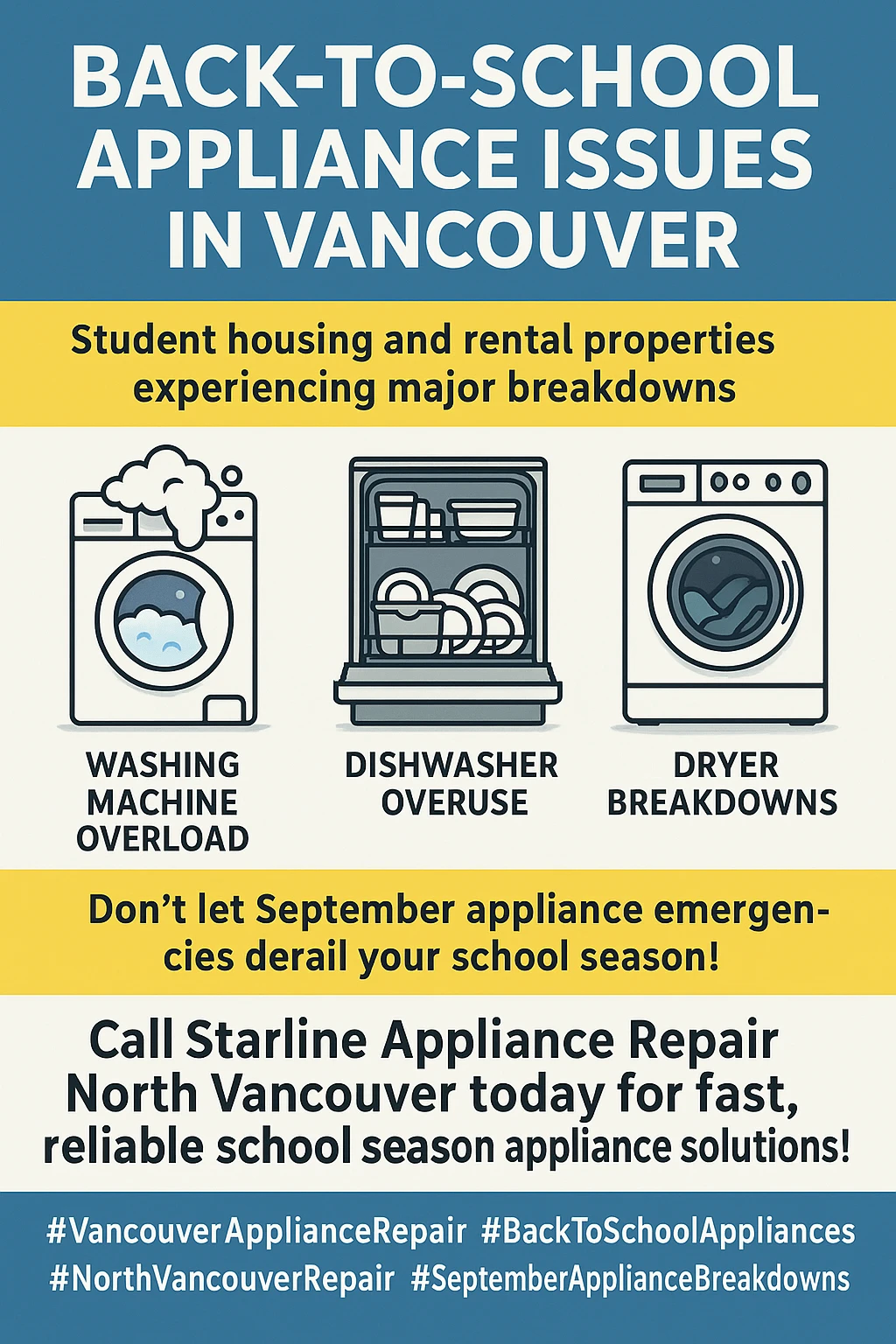
- Student housing and rental properties experience accelerated failure rates due to shared appliance usage and delayed maintenance responses
- Pre-September maintenance protocols can prevent 70-80% of back-to-school appliance failures through early problem detection and component care
- Load management and staggered usage during peak demand periods dramatically reduce stress on electrical systems and appliance components
Understanding Vancouver’s September Appliance Crisis
The back-to-school season transforms how Vancouver households use their appliances, creating a cascade of stress factors that even well-maintained equipment struggles to handle. When families shift from relaxed summer routines to structured academic schedules, appliances face unprecedented demand that can overwhelm systems designed for moderate, distributed usage.
During normal household operations, your washing machine might run 4-5 cycles per week spread across several days. But during back-to-school prep, families often run 3-4 cycles daily for weeks straight, washing accumulated summer clothing, preparing uniforms, and handling the increased laundry that comes with more structured meal times and activities. This compressed usage pattern forces motors, pumps, and heating elements to operate far beyond their typical duty cycles.
Vancouver’s unique housing market, with its high concentration of student rentals and multi-family properties, amplifies these problems. When multiple residents in shared housing simultaneously prepare for school, a single washing machine might face usage equivalent to a busy laundromat, but without commercial-grade components designed for that intensity. The result is predictable: catastrophic failures right when families need their appliances most.
The Hidden Electrical System Overload Problem
One of the most overlooked causes of September appliance failures involves electrical system stress that occurs when multiple high-power appliances operate simultaneously during back-to-school preparations. Many Vancouver homes, particularly older properties, have electrical systems that simply weren’t designed to handle the power demands of modern appliances running concurrently.
When you’re running a washing machine (drawing 3,500-5,000 watts), dishwasher (1,200-2,000 watts), and dryer (2,000-6,000 watts) at the same time – a common scenario during intensive school prep – you’re potentially demanding 10,000+ watts on circuits designed for 1,800 watts maximum safe capacity. This overload creates voltage fluctuations that damage the computerized control boards in modern appliances.
These electrical surges particularly affect the sensitive electronic components that control temperature, timing, and safety functions in contemporary refrigerators, dishwashers, and washing machines. What appears to be three separate appliance failures occurring within days of each other is often a single electrical problem cascading through your home’s systems. Understanding this connection can save thousands in unnecessary appliance replacements.
Washing Machine Vulnerabilities During Peak Demand
The transition from electrical system stress to specific appliance vulnerabilities reveals why washing machines fail most frequently during Vancouver’s back-to-school rush. North Vancouver appliance repair companies report washer service calls increase by 150-200% during September, with most failures directly related to overloading and intensive usage patterns that characterize school preparation activities.
The fundamental problem stems from human behavior during high-stress periods. When facing mountains of laundry, families naturally try to maximize efficiency by cramming as much as possible into each load. However, overloading washing machines beyond 75% capacity causes motor burnout, bearing damage, and suspension system failure. The drum bearings that support the rotating drum experience accelerated wear when handling weights beyond design specifications.

Overloaded machines also become severely unbalanced during spin cycles, creating violent vibrations that damage internal components and can literally cause machines to walk across laundry room floors. The cumulative effect of consecutive overloaded cycles – common during back-to-school season – transforms minor wear into catastrophic failures requiring complete motor or suspension system replacement.
Motor Stress and Thermal Damage
When washing machine motors work harder to rotate overloaded drums, they generate excessive heat that degrades electrical connections and can cause complete motor burnout. Motors designed for moderate household use face industrial-level stress during intensive school preparation periods, particularly when families run multiple consecutive cycles without allowing adequate cooling time between loads.
The thermal stress becomes particularly problematic when combined with Vancouver’s hard water conditions, which create mineral deposits on internal components that further restrict motor efficiency. Professional appliance repair services report that most September washing machine failures involve preventable motor damage that could have been avoided through proper load management and component maintenance.
Dishwasher Pump and Drainage Failures
Following the pattern established with washing machines, dishwashers represent the second most common appliance failure point during Vancouver’s September peak demand period. The intensive meal preparation that accompanies back-to-school routines places extraordinary stress on dishwasher pumps and drainage systems, particularly when combined with inadequate maintenance of filters and spray arms.
During normal household operation, dishwashers might run once daily with moderate loads and pre-rinsed dishes. But back-to-school season brings multiple daily cycles processing heavily soiled dishes from increased cooking activities, lunch preparation, and the general chaos of family meal management. These intensive usage patterns overwhelm pump systems designed for moderate residential use, particularly when food debris accumulates faster than filtration systems can handle.
The dishwasher pump contains fine-tolerance passages that distribute water at specific pressures and flow rates. When filters aren’t cleaned regularly – a maintenance task often neglected during busy school preparation periods – food particles rapidly clog these passages. The pump must work harder to maintain water pressure, generating excess heat that damages internal components and eventually leads to complete pump failure.
Hard Water Complications
Vancouver’s water quality creates additional complications for dishwashers during intensive usage periods. Hard water minerals form limescale deposits on spray arms, heating elements, and internal passages, further restricting water flow and reducing pump efficiency. These mineral accumulations accelerate dramatically during periods of frequent use, with spray arms becoming completely clogged after just three to four weeks of intensive operation.
The combination of food debris accumulation and mineral deposits creates conditions where dishwasher pumps fail catastrophically, often manifesting as standing water, drainage problems, or complete loss of spray function. Regular filter cleaning and monthly descaling during August can prevent most of these failures before September demand peaks arrive.
Refrigerator Compressor Strain and Continuous Operation
While washing machines and dishwashers experience dramatic usage spikes during back-to-school season, refrigerators face a different but equally problematic stress pattern: continuous operation against blocked airflow and frequent door openings. As families stockpile fresh produce, prepare meals in advance, and maintain larger quantities of beverages and frozen foods, refrigeration systems must work constantly to maintain safe temperatures.
The refrigerator compressor – the most critical and expensive component – experiences particular stress when fighting against overstuffed shelves that block air vents and frequent door openings that allow warm air infiltration. During back-to-school meal preparation, refrigerator doors open dozens of additional times daily as family members retrieve lunch items, snacks, and meal components. Each opening forces the compressor to work harder to restore proper temperature.
Dirty condenser coils compound this problem by forcing compressors to work harder and generate excessive heat, which can cause complete compressor failure. The door seals that maintain airtight closure deteriorate more rapidly with frequent use, allowing continuous air leakage that forces compressors into near-constant operation.
Prevention Through Fall Maintenance
Professional maintenance during August – before September demand peaks arrive – represents the optimal strategy for preventing refrigerator failures. Fall maintenance protocols can identify worn components and address emerging problems before they precipitate catastrophic failures. This maintenance includes condenser coil cleaning, door seal inspection, and thermostat calibration to ensure efficient operation during intensive usage periods.
The financial calculation strongly favors preventive maintenance, as professional diagnostic services costing $120-200 can prevent $1,000+ compressor replacement costs. Many Vancouver homeowners delay these maintenance tasks until problems develop, leaving refrigeration systems vulnerable precisely when they face maximum operational stress.
Student Housing and Rental Property Challenges
Vancouver’s substantial student population creates unique appliance vulnerability patterns that extend far beyond typical household failures. Shared kitchen appliances in student housing face cumulative usage that can represent two to three times the intensity of single-family operations, creating stress conditions that precipitate failures within weeks of the academic year beginning.
The fundamental challenge involves misaligned incentives between appliance usage and maintenance responsibility. Individual students experience minimal direct consequence for overloading washing machines or running excessive dishwasher cycles, since repair costs typically fall to landlords rather than residents. This disconnect between usage and responsibility creates conditions where prevention-oriented behaviors receive minimal reinforcement, allowing appliance abuse patterns to develop unchecked.
Property managers throughout Vancouver report that September represents their highest-risk month for appliance failures, with tenant turnover and multiple simultaneous new residents creating perfect conditions for emergency repairs. The transient nature of student housing means residents typically lack familiarity with proper equipment operation, leading to operational errors that would be immediately corrected in owner-occupied homes.
Communication Delays and Maintenance Response
A frequently overlooked factor involves communication delays between tenants and property managers during peak move-in periods. When tenants discover malfunctioning appliances in early September, scheduling repairs can take days or weeks due to capacity constraints at repair services. These delays transform manageable maintenance issues into catastrophic failures requiring complete appliance replacement.
Property managers who implement pre-September maintenance protocols and establish clear tenant communication procedures can substantially reduce failure rates. Pre-move-in appliance inspections, August preventive maintenance scheduling, and expedited repair response systems during peak demand periods prevent minor issues from developing into major problems requiring emergency service.
Preventive Maintenance Strategies
The most effective approach to preventing September appliance failures involves implementing comprehensive maintenance protocols during August, before intense usage patterns commence and while repair services maintain reasonable scheduling availability. This critical window represents the optimal opportunity to identify emerging problems, address component deterioration, and prepare systems for intensive demand.
A thorough pre-September maintenance protocol should encompass washing machine inspection focusing on drum balance, suspension system integrity, and hose connections. Dishwasher maintenance should include filter cleaning, spray arm inspection, and drain system verification to ensure water flows freely without obstruction. Refrigerator maintenance should focus on condenser coil cleaning, door seal inspection, and thermostat calibration.

Professional maintenance services throughout Vancouver can provide comprehensive inspections that identify emerging problems before failures develop, typically costing $120-200 per appliance but providing substantial protection against catastrophic failures requiring emergency repair or replacement. The financial calculation strongly favors preventive maintenance, as these modest investments can prevent $1,000+ in emergency repair costs.
Load Management During Peak Demand
During back-to-school rush periods, conscious load management and staggered usage patterns can dramatically reduce appliance stress. Rather than running consecutive washing machine cycles, spacing loads across multiple days allows motors to cool between operations and reduces cumulative thermal stress on electrical connections. Similarly, dishwasher usage should be distributed rather than concentrated, with cycles operated at appropriate capacity levels.
Residential electrical systems should avoid simultaneous operation of multiple high-power appliances, with users consciously timing laundry for periods when major cooking appliances are not in use. These management practices require minimal cost investment but necessitate conscious household coordination that back-to-school chaos can easily disrupt if not deliberately prioritized.
Frequently Asked Questions
Why do appliances specifically fail during September back-to-school season?
Appliances fail during September due to the convergence of multiple stress factors including intensive usage from clothing and meal preparation, increased electrical demand from simultaneous operation, and cumulative thermal stress from continuous use. The fundamental cause involves compressed usage patterns that exceed design specifications for residential appliances. Prevention strategies focusing on load distribution, August maintenance, and conscious usage management can substantially mitigate these risks.
What appliance fails most commonly during back-to-school season in Vancouver?
Washing machines represent the most frequently failing appliance during back-to-school season, primarily due to overloading during intensive laundry preparation combined with consecutive operating cycles that provide insufficient cooling time between loads. Dishwashers represent the second most common failure point due to intensive usage coinciding with inadequate filter maintenance and hard water mineral accumulation. Refrigerators experience significant stress but generally exhibit more gradual failure development compared to washing machines and dishwashers.
The pattern typically involves motor burnout in washing machines, pump failures in dishwashers, and compressor strain in refrigerators, all stemming from usage intensities that far exceed normal household patterns during the critical September preparation period.
How much do emergency appliance repairs cost in Vancouver during September?
Emergency appliance repair services in Vancouver typically charge $150-300 for diagnostic service calls during peak demand periods, with repair costs ranging from $300-1,000+ depending on specific problems and required components. Dishwasher pump replacement typically costs $400-700, washing machine motor repairs range from $350-900, and refrigerator compressor replacement represents the most expensive repair at $800-1,500+. Prevention-focused maintenance costing $100-200 per appliance during August can prevent these emergency repair costs that often exceed $1,000 when failures develop during September peak demand.
Can homeowners prevent September appliance failures through personal maintenance?
Homeowners can substantially reduce September failure risk through personal maintenance including washing machine load management, dishwasher filter cleaning, refrigerator coil cleaning, and regular inspection for deterioration signs. However, professional diagnostic services during August can identify emerging problems that personal inspection might miss, and professional maintenance of complex systems often requires specialized tools and expertise. The optimal strategy combines personal preventive maintenance with professional diagnostic services that identify problems requiring specialized attention.
Simple practices like avoiding overloading, cleaning filters monthly, and spacing out intensive usage can prevent many failures, but professional assessment provides additional protection against problems requiring technical expertise to identify and address.
Wrapping Up
Vancouver’s back-to-school rush creates a predictable pattern of appliance stress and failures that can be largely prevented through understanding vulnerability patterns and implementing targeted prevention strategies. The convergence of intensive laundry preparation, accelerated meal preparation, electrical system stress, and component wear acceleration during September creates entirely manageable challenges when approached proactively rather than reactively.
Whether you’re managing a single-family household or overseeing student rental properties, the key lies in recognizing September as a critical period requiring preparation rather than a source of inevitable emergency repairs. If your appliances are showing signs of stress or you want to prevent costly September breakdowns, Starline Appliance Repair North Vancouver offers comprehensive pre-season inspections and maintenance services designed specifically to help Vancouver families navigate back-to-school season without appliance emergencies.