

You run the dishwasher, wait through the full cycle, open the door and the dishes still look like you never bothered. This guide walks you through every likely cause, from the easy five-minute fixes to the less obvious culprits that even experienced homeowners miss.Vancouver homes deal with moderately hard water coming off the North Shore mountains, and that mineral content does a number on dishwasher components over time. Spray arm nozzles clog faster, filters cake up with a chalky residue, and rinse performance suffers in ways that aren’t immediately obvious. At Starline Appliance Repair North Vancouver, we see this pattern constantly homeowners convinced their machine is dying when really it just needs a thorough clean and a few adjustments.The good news is that most dishwasher performance problems are fixable at home, often in under an hour. A few require a technician, but knowing which is which saves you time, money, and the frustration of throwing parts at a problem that has a simpler root cause.
Key takeaways
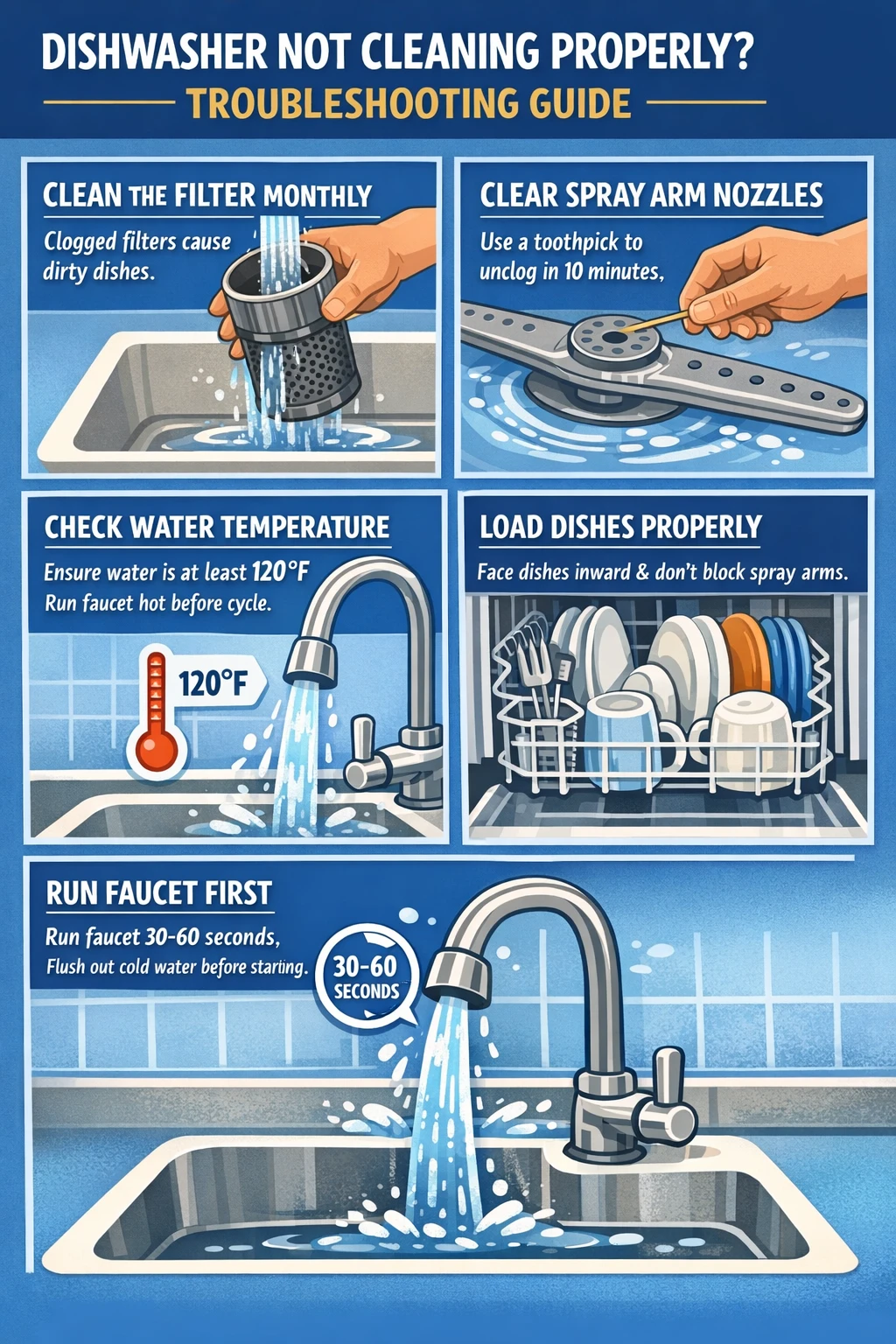
- A clogged filter is the single most common reason dishes come out dirty clean it at least once a month under hot running water.
- Spray arm nozzles can be cleared with a toothpick in about ten minutes, and this fix alone solves a surprising number of cleaning failures.
- Water entering the dishwasher should be around 120°F for detergent to dissolve and activate properly too cold and you will see soap residue on everything.
- Improper loading blocks water from reaching dishes; plates facing inward, bowls tilted down, and tall items on the sides make a real difference.
- Running the kitchen faucet for 30 to 60 seconds before starting a cycle ensures hot water hits the machine right away instead of cold water sitting in the pipes.
- If the detergent tab is landing undissolved at the bottom of the tub, suspect a blocked dispenser door, water temperature problems, or a clogged spray arm preventing water from reaching the dispenser at all.
Why your dishwasher isn’t cleaning properly
Most of the time, a dishwasher not cleaning dishes comes down to one of four things: a dirty filter, blocked spray arms, wrong water temperature, or a loading problem. These four causes cover probably 80 percent of the calls we get. The machine sounds fine, drains fine, runs through its cycles but the dishes come out with food still on them, or with a gritty film, or with undissolved detergent sitting in the bottom of the tub.The other 20 percent involves mechanical failures: a broken soap dispenser spring, a failing water inlet valve, or a heating element that’s given up. These take a bit more digging to identify, but the diagnostic process is the same either way work through the simple stuff first before assuming the worst.One thing worth knowing: modern dishwashers actually work better with a bit of food residue on the dishes. The enzymes in most detergents need something to activate against. Fully pre-rinsing everything can, counterintuitively, leave spots and film on glassware. Scrape off big chunks, but don’t scrub the plates clean before loading.
The filter: start here every time
Honestly, if you have never cleaned your dishwasher filter, this is almost certainly your problem. The filter sits at the bottom of the tub usually a cylindrical piece that twists out, sometimes covered by a flat mesh screen underneath the lower spray arm. Pull the bottom rack out, locate it, and give it a look.Dishwashers made before roughly 2010 typically had self-cleaning filters that ground food particles down automatically. Noisier, but low-maintenance. Newer, quieter machines use a manual filter that collects everything and needs to be cleaned out by hand. If you have one of those and you have never touched it, what you find might surprise you.To clean it: twist or unclip the filter assembly out, separate the cylindrical piece from the flat mesh if your model has both, and rinse everything under hot running water. For stubborn buildup, soak the pieces in hot soapy water for a few minutes, then scrub gently with a soft brush. Never use anything abrasive you can damage the mesh. Reassemble, twist to lock, and run a cycle. Many people who do this for the first time report an immediate improvement. 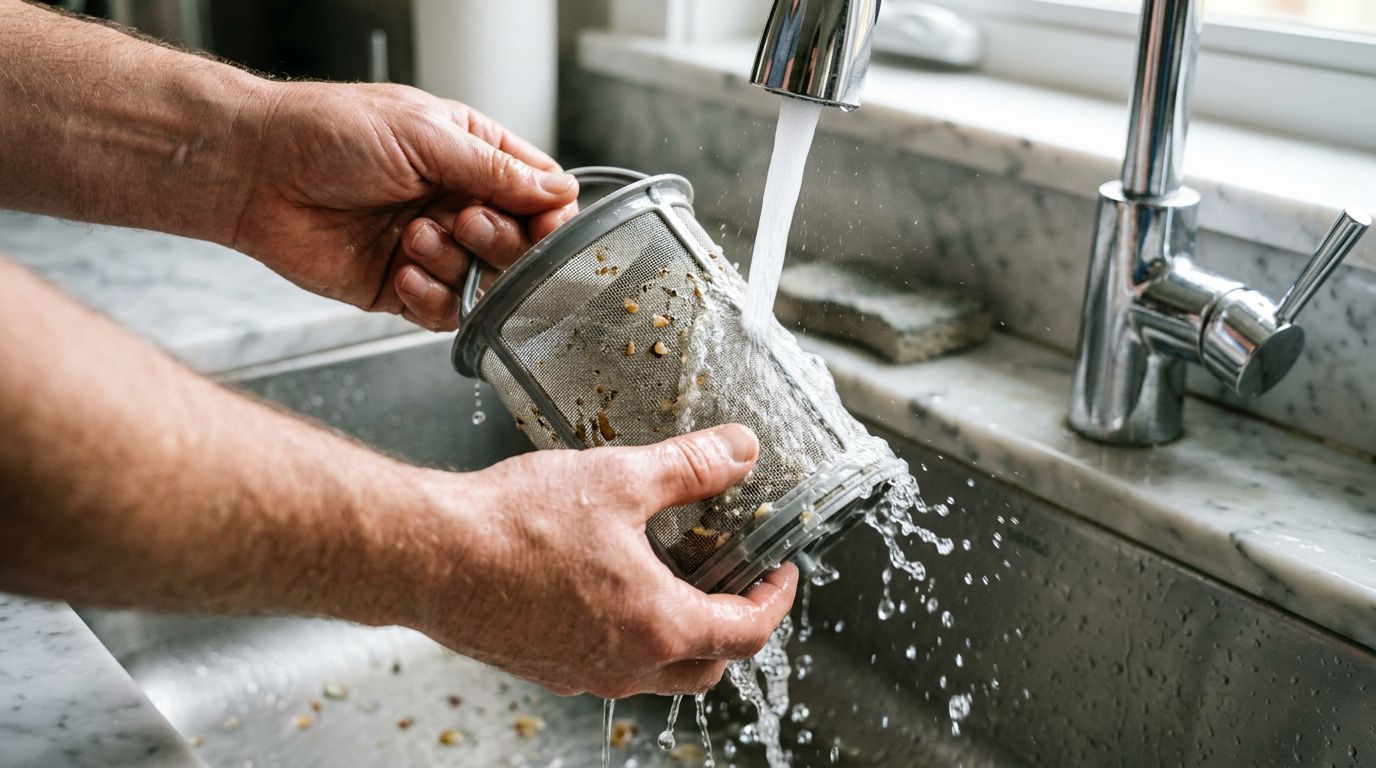
How often should you clean it?
Once a month is a reasonable target for an average household. If you run the machine daily or don’t scrape dishes before loading, every two weeks is better. In older homes around Lynn Valley and Canyon Heights, where the water tends to carry more mineral sediment, we find filters clogging faster than the manufacturer’s recommendations suggest. Check yours after the first cleaning and you’ll get a feel for your own machine’s pace.
Spray arms: the part most people forget
The spray arms are the spinning propeller-like components that throw water at your dishes during the wash cycle. There is usually one below the bottom rack, one under the top rack, and sometimes a third at the very top. Each arm has small jets along it, and those jets clog.Food particles, hard water deposits, and occasionally bits of broken glass or small labels find their way into the spray arm nozzles. When that happens, water pressure drops and distribution becomes uneven. The dishes near a working jet get clean. The ones near a blocked jet don’t.To clean them: spin each arm by hand first. It should rotate freely with no resistance. If it catches or wobbles, something is blocking it. Most spray arms unclip or unscrew for removal check your manual if it isn’t obvious. Once you have one off, hold it up to the light and look through each hole. Use a toothpick or thin bristled brush to clear any blockages. Rinse under warm water, shake out any loose debris, and reinstall. 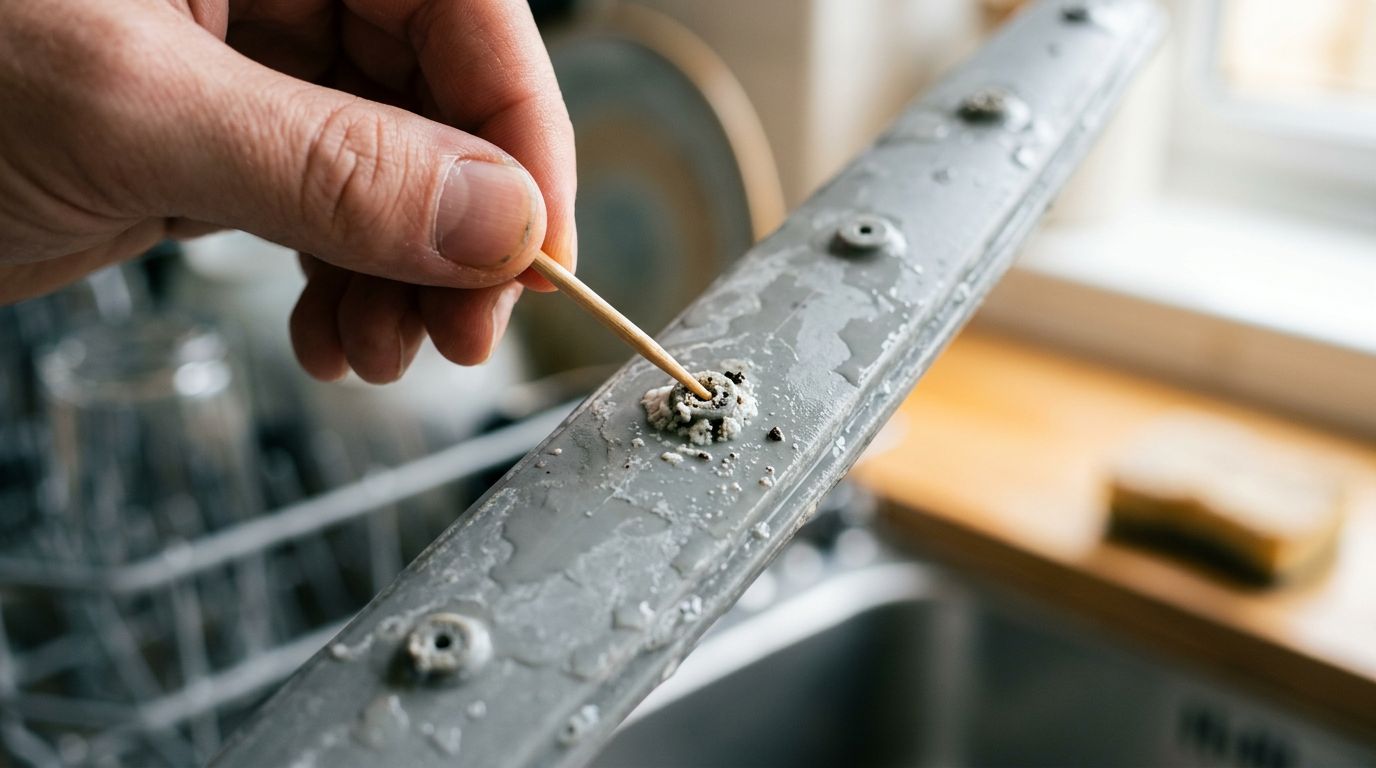 One thing to check while you are in there: make sure the spray arms can actually rotate freely once dishes are loaded. A tall pot on the bottom rack, or a cutting board standing upright, can physically stop the arm from turning. A lot of people load the machine perfectly on empty and then accidentally block the spray arm with the last item they put in.
What about the rubber seal at the back?
There is a rubber washer valve where the water supply connects to the upper spray arm at the back of the tub. This seal degrades over time and, when it goes, water bypasses the spray arm entirely rather than being forced through the jets. The symptom is a dishwasher that runs normally but barely cleans the top rack. The seal itself is usually inexpensive often just a few dollars as a replacement part. Remove the top rack, look at the back panel, and inspect the seal. If it looks cracked, compressed flat, or visibly deteriorated, replacement is worth trying before spending money on anything else.
Water temperature and detergent
This one catches people off guard. Your dishwasher needs water at around 120°F to function properly. Below that, detergent doesn’t dissolve or activate the way it should, grease doesn’t break down, and you get a cycle that technically ran but didn’t clean.A simple test: run the kitchen faucet nearest your dishwasher until the water runs hot, then start the machine. This flushes cold water out of the supply line so the dishwasher gets hot water right from the first fill. Many people notice an immediate improvement from this one habit change alone.If your water heater is set below 120°F, raise it. If it is already at 120°F and dishes still come out with undissolved detergent or a soapy film, the heating element inside the machine may be failing. You can test this roughly by opening the door mid-cycle the water inside should be hot to the touch, not lukewarm.
Detergent matters more than people think
Not all dishwasher detergents perform equally, and the format matters. Powder detergents can bundle and not dissolve fully, especially in cooler water or older machines. Liquid and gel detergents can leave more residue. Pre-measured pods and tablets generally perform the most consistently, but there is a wrinkle: pods designed with a pre-wash compartment should ideally be placed in the bottom of the tub rather than the dispenser, so the pre-wash agent releases during the pre-wash cycle instead of sitting there getting gummy.If you have hard water, a rinse aid makes a noticeable difference. It helps water sheet off dishes cleanly instead of beading and leaving mineral spots. Keep the rinse aid dispenser filled and you will see better results on glassware and cutlery. For a one-time clean of mineral buildup inside the machine, pour about three cups of white vinegar into the bottom of an empty dishwasher and run a full hot cycle. It works, and it’s cheap.
Loading: the fix that costs nothing
Poor loading is responsible for a lot of “my dishwasher isn’t cleaning” calls. The water has to physically reach every surface to clean it. If dishes are nested together, stacked, or blocking the spray arms, it won’t.A few practical rules that actually make a difference:
- Cups and glasses go on the top rack, angled so water drains out rather than pooling inside.
- Plates, pots, and larger items go on the bottom rack, facing inward toward the spray arm.
- Tall champagne flutes and wine glasses are safer in the bottom rack where dedicated glass holders can secure them.
- Spoons and forks should be mixed in the cutlery basket rather than nested together two spoons face-to-face will sit together the whole cycle and come out with food still between them.
- Nothing should block the detergent dispenser door. Load the dishwasher and then close the door and open it again. Watch whether anything stops the dispenser from swinging open fully.
- Large baking sheets and cutting boards belong along the outer edges or the very back, not blocking the center where the spray arm coverage is strongest.
One thing worth knowing about Bosch and similar European-style dishwashers: the third rack at the top is for flatware, not a bonus shelf for overflow. Overloading any rack reduces cleaning performance across the whole machine. 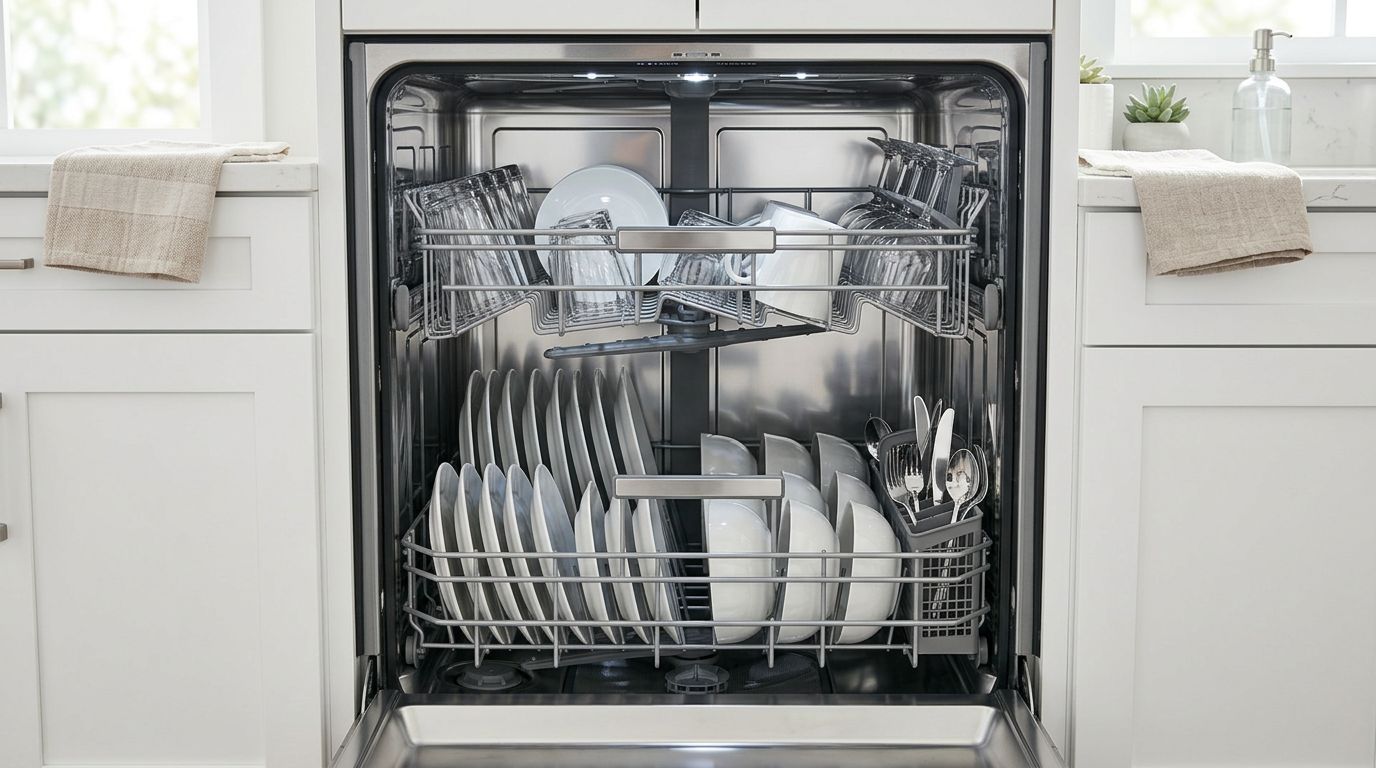 We get a lot of calls from homeowners in Edgemont Village and Deep Cove who have recently upgraded to a newer, quieter European-brand machine and are frustrated that it cleans worse than their old one. Often the loading approach that worked fine for their old American-style machine doesn’t translate, and small adjustments make a significant difference.
When it’s something mechanical
If you have cleaned the filter, cleared the spray arms, confirmed water temperature, and sorted out your loading and the machine still leaves dishes dirty you are probably dealing with a mechanical fault.The most common ones worth checking:The soap dispenser door. If the spring inside is broken or the door is jammed, detergent never releases during the wash cycle. You will find the detergent tab sitting undissolved at the end of the cycle. A gentle clean with a soft brush and some hot water sometimes frees a sticky dispenser. If the spring is actually broken, it needs replacing. You can find replacement dispenser parts by model number through appliance parts retailers.The water inlet valve. This controls how much water enters the machine. A partially clogged or failing valve reduces water volume and pressure, which affects cleaning across the board. The symptom is often a machine that sounds like it is running normally but cups placed on both racks come out empty or barely wet. A completely failed valve may make a hammering noise when the machine runs.The heating element. If your dishes come out cold and wet after a drying cycle, or detergent consistently fails to dissolve despite hot water at the tap, the heating element may have failed. This is a repair worth having a professional assess not because it is dangerous to look at, but because testing it properly requires checking the continuity of the element, which is easier with the right tools.If you notice water pooling under the dishwasher, or the machine stops mid-cycle, or error codes are showing on the control panel that you cannot clear through a reset those are signs to stop troubleshooting yourself and call someone. Water intrusion can cause serious damage fast, and electrical faults in appliances are not something to guess through.The ENERGY STAR program maintains useful guidance on dishwasher efficiency and performance standards if you are trying to decide whether repair or replacement makes more sense for an older machine.
Frequently asked questions
These are the questions we hear most often once people have worked through the basics. If you have already cleaned the filter and checked the spray arms but something still feels off, one of these probably applies.
Why does my dishwasher leave white film or spots on glasses?
White film and spots on glasses are almost always caused by hard water mineral deposits or too much detergent. In Vancouver, the water is moderately hard, and without rinse aid those minerals dry onto glass surfaces. Fill your rinse aid dispenser and run a few cycles. If the film is already there, a cycle with white vinegar in the bottom of the tub will dissolve most of it. Switching from powder or gel detergent to a quality tab or pod often reduces spotting as well, since the premeasured format prevents overdosing.
My dishwasher tablet isn’t dissolving fully — what is causing that?
Three things cause this most often. First, water temperature if the incoming water is too cold, detergent simply won’t dissolve properly. Run the tap hot before starting the machine. Second, the dispenser door may be blocked by a utensil or tall item preventing it from opening. Third, if you are using pods with a pre-wash component, placing them in the dispenser rather than the tub bottom can leave them sitting in hot water so long that they partially dissolve and then re-solidify. Try dropping the pod into the bottom of the tub directly on your next cycle and see if that changes things.
The top rack always comes out dirty but the bottom rack is fine. Why?
This is almost always a spray arm issue specific to the upper arm. Either the upper spray arm is clogged, it isn’t rotating freely, or the water supply seal at the back of the tub has failed. Remove the top rack and manually spin the upper spray arm it should turn with light resistance, not stick or wobble. Check the jets with a toothpick. If the arm is clear but the top rack still underperforms, inspect the rubber seal where the water supply connects to the arm at the back of the tub. A degraded seal lets water bypass the arm entirely.
How do I know when to repair versus replace my dishwasher?
A useful general guideline is that if the repair costs more than half the price of a comparable new machine, replacement usually makes more sense. For a ten-year-old entry-level machine with a failed motor or control board, replacement is often the smarter call. For a newer mid-range or high-end machine with a clogged filter, worn seal, or faulty dispenser spring, repair almost always wins. Many dishwashers that appear to be failing are actually fixable for well under $100 in parts. According to manufacturer support documentation, many dishwashers have expected lifespans of 9 to 12 years with regular maintenance if yours is younger than that and hasn’t had a history of problems, it is worth investigating before assuming it is done.
Is it safe to use vinegar in my dishwasher regularly?
Occasional use is fine, but do not make it a weekly habit. White vinegar is acidic and, over time, can degrade the rubber door gaskets and internal seals if used too frequently. Once a month or once every couple of months as a descaling treatment is reasonable. Do not add it to the rinse aid dispenser as a substitute for commercial rinse aid it will not perform the same function and repeated acid exposure to the dispenser seals is not ideal.
Wrapping up
Most dishwasher performance problems are not appliance death sentences. Clean the filter, clear the spray arms, confirm your water temperature, and load the machine thoughtfully those four things resolve the overwhelming majority of cases. If you work through all of that and still have problems, you are most likely looking at a mechanical fault that a technician can diagnose quickly.If you would rather not spend a Saturday afternoon with your hands in the machine, or you have already been through the troubleshooting steps and are still stuck, that is exactly what we are here for. At Starline Appliance Repair North Vancouver, we handle dishwasher repair north vancouver and surrounding areas regularly, and can usually identify the root cause on the first visit. Give us a call and we will help you figure out whether a repair makes sense or whether it is time to move on.